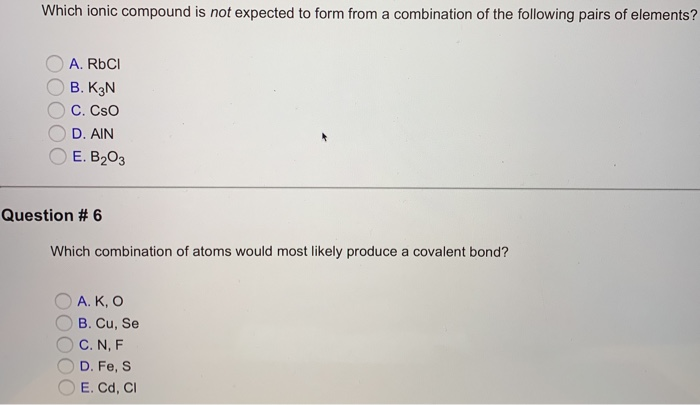
Which Pairs Of Elements Are Likely To Form Ionic Compounds . A pair of elements will most likely form an ionic bond if one is a metal and one is a nonmetal. Actet ly gaining the other (6.
Solved 13 Which Pair Of Elements Is Most Likely To Form An | Chegg.com from www.chegg.com
You can view more similar questions or. Metals and nonmetals tend to form ionic bonds.
Solved 13 Which Pair Of Elements Is Most Likely To Form An | Chegg.com
So for a we have lithium and chlorine. We have oxygen and roaming. For example, the metal calcium (ca) and the nonmetal chlorine (cl) form the ionic compound calcium chloride (cacl2).
Source: www.youtube.com
Which element would provide one atom to make an ionic bond with calcium? A chemist performs a series of reactions that produce binary lithium compounds. C and o d.al and rb e.o and z
Source: www.chegg.com
You can view more similar questions or. A) cl and i b) al and k c) cl and mg d) c and s e) al and mg Therefore, i would say that this would a form mhm and i on a compound for b.
Source: www.chegg.com
Which pair of elements is most likely to form an ionic compound? The elements that tend to form ionic compounds include cadmium, chromium, cobalt, iron, gold, copper, nickel, manganese, mercury, silver, zinc, tin, bismuth and lead. If the size difference is such that cation is small and anion is very large, they form bond with more covalent character.
Source: www.chegg.com
Potassium and sulfur won't form an ionic compound. Usually, a metallic element and a non metallic element form an ionic compound, but. A chemist performs a series of reactions that produce binary lithium compounds.
Source: www.chegg.com
The models below represent the ionic radii of compounds formed by reacting lithium with. Magnesium and chlorine will form an ionic compound. So for a we have lithium and chlorine.
Source: www.chegg.com
Which pair of elements is most likely to form an ionic compound? Which element would provide one atom to make an ionic bond with calcium? Which pair of elements would be most likely to form an ionic compound a.
Source: www.chegg.com
Ionic bonds form when a nonmetal and a metal exchange electrons, while covalent bonds form when electrons are shared between two nonmetals. The models below represent the ionic radii of compounds formed by reacting lithium with. Which of the following pairs of elements would be most likely to form an ionic compound?
Source: www.chegg.com
Which of these pairs of elements would be most likely to form an ionic compounds? Its valence mg forms an ionic bond to ed by donating electrons to two el atoms. For example, the metal calcium (ca) and the nonmetal chlorine (cl) form the ionic compound calcium chloride (cacl2).
Source: brainly.com
Ionic compounds generally form between elements that are metals and elements that are nonmetals. Metals and nonmetals tend to form ionic bonds. Therefore, i would say that this would a form mhm and i on a compound for b.
Source: www.chegg.com
These are well, oxygen is a non metal. Therefore, i would say that this would a form mhm and i on a compound for b. Ionic bonds form when a nonmetal and a metal exchange electrons, while covalent bonds form when electrons are shared between two nonmetals.
Source: www.chegg.com
These types of ionic compounds are. The elements that tend to form ionic compounds include cadmium, chromium, cobalt, iron, gold, copper, nickel, manganese, mercury, silver, zinc, tin, bismuth and lead. Which of the following pairs of elements is most likely to form an ionic compound?
Source: www.clutchprep.com
K looses one electron to form monoatomic ion; For example, the metal calcium (ca) and the nonmetal chlorine (cl) form the ionic compound calcium chloride (cacl2). So for a we have lithium and chlorine.
Source: www.chegg.com
The elements that tend to form ionic compounds include cadmium, chromium, cobalt, iron, gold, copper, nickel, manganese, mercury, silver, zinc, tin, bismuth and lead. K + and i gains one electron to form i −. A pair of elements will most likely form an ionic bond if one is a metal and one is a nonmetal.
Source: www.chegg.com
Which of the following most likely to form an ionic compound and ionic compounds is formed when we have a metal iron paired up with a nonmetal lion. These types of ionic compounds are composed of monatomic cations and anions. For example, the metal calcium (ca) and the nonmetal chlorine (cl) form the ionic compound calcium chloride (cacl2).
Source: www.chegg.com
Ionic compounds generally form between elements that are metals and elements that are nonmetals. Metals and nonmetals tend to form ionic bonds. Which pair of elements would be most likely to form an ionic compound a.
Source: slideplayer.com
Mg loses two elections to form mght & achieves a complete octet, the el achiere an one election of form cl ions. K looses one electron to form monoatomic ion; Lithium and chlorine will form lithium chloride (licl) oxygen and bromine will form bromine dioxide, because of two electrons from oxygen are transferred.
Source: slideplayer.com
Ionic compounds generally form between elements that are metals and elements that are nonmetals. These types of ionic compounds are composed of monatomic cations and. Ionic compounds generally form between elements that are metals and elements that are nonmetals.
Source: socratic.org
Which of these pairs of elements would be most likely to form an ionic compounds? A pair of elements will most likely form an ionic bond if one is a metal and one is a nonmetal. Which pair of elements is most likely to form an ionic compound?
Source: www.chegg.com
Which of the following pairs of elements would be most likely to form an ionic compound? The correct pairs of elements likely to form ionic compounds are, potassium and sulfur, magnesium and chlorine. Which of the following pairs of elements is most likely to form an ionic compound?
Source: www.chegg.com
So for a we have lithium and chlorine. Therefore, i would say that this would a form mhm and i on a compound for b. Which pair of elements is most likely to form an ionic compound?