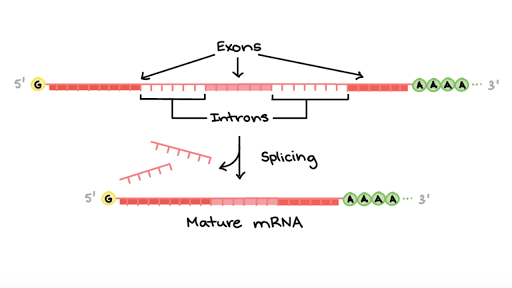
Which Pre Mrna Processing Step Is Important For Initiating Translation . In rare cases, the mrna transcript can be “edited” after it is transcribed. The process by which the mrna codes for a particular protein is known as translation.
Coupling Mrna Processing With Transcription In Time And Space | Nature Reviews Genetics from www.nature.com
5' cap functions to protect mrna in the cytoplasm and attaches mrna with ribosome for initiating. Capping describes the addition of a methylated guanine cap to the 5′ end of mrna.
Coupling Mrna Processing With Transcription In Time And Space | Nature Reviews Genetics
In rare cases, the mrna transcript can be “edited” after it is transcribed. If the process errs by even a single nucleotide, the sequence of the rejoined exons would be shifted, and the resulting protein would be nonfunctional. The mrna molecule would stabilize and start the process of translation within the nucleus of the cell.
Source: www.numerade.com
Mrna processing and nuclear export. Capping, resulting in the addition of two methyl groups on the 5ʼ end, is fundamental for both. Transcribe and translate the following.
Source: www.nature.com
In rare cases, the mrna transcript can. In rare cases, the mrna transcript can be “edited” after it is transcribed. If the process errs by even a single nucleotide, the sequence of the rejoined exons would be shifted, and the resulting protein would be nonfunctional.
Source: www.numerade.com
This process describes the conversion of precursor messenger rna into mature messenger rna (mrna). In the process, the ribosome translates the mrna produced from dna into a chain of specific amino acids. It includes modifications such as adding 5' cap, splicing, editing, and 3' polyadenylation tail, resulting in translating more than one protein from a single gene.
Source: www.nature.com
The mrna molecule would move out of the nucleus and create more copies of the mrna molecule. This chain of amino acids leads to protein synthesis. In rare cases, the mrna transcript can be “edited” after it is transcribed.
Source: www.numerade.com
The mature mrna is exported from the nucleus to the cytosol, where it is translated. The mrna molecule would move out of the nucleus and create more copies of the mrna molecule. In rare cases, the mrna transcript can.
Source: opentextbc.ca
Before transcription can take place, the dna double helix must unwind near the gene that is getting transcribed. With the genes bound in the nucleus, transcription occurs in the nucleus of the cell and the mrna transcript must be transported to the cytoplasm. It is a process where the expense of atp is required and this energy is given by.
Source: studylib.net
Transcribe and translate the following. Translational control provides a fast adaptive response to environmental cues and is essential for maintaining protein homeostasis in cells. Capping describes the addition of a methylated guanine cap to the 5′ end of mrna.
Source: wou.edu
Mrna translation in eukaryotes can includes three steps: The mrna molecule would move out of the nucleus and create more copies of the mrna molecule. Eukaryotic mrna precursors must be processed in the nucleus (e.g., capping, polyadenylation, splicing) in ribosomes before they are exported to the cytoplasm for translation.
Source: www.frontiersin.org
The mature mrna is exported from the nucleus to the cytosol, where it is translated. This process describes the conversion of precursor messenger rna into mature messenger rna (mrna). In rare cases, the mrna transcript can be “edited” after it is transcribed.
Source: www.khanacademy.org
It is a process where the expense of atp is required and this energy is given by the charged trna. In rare cases, the mrna transcript can. These modifications are 5' capping, 3' polyadenylation, and rna splicing, which occur in the cell nucleus before the rna is translated.
Source: www.numerade.com
5' cap functions to protect mrna in the cytoplasm and attaches mrna with ribosome for initiating. Mrna processing and nuclear export. Even though there are six codons, the fifth codon corresponds to a stop, so the sixth codon would not be translated.
Source: www.numerade.com
Its presence is vital for the recognition of the molecule by ribosomes, and to. This chain of amino acids leads to protein synthesis. Protein synthesis is controlled primarily at the step of mrna translation initiation.
Source: www.numerade.com
The mrna molecule would stabilize and start the process of translation within the nucleus of the cell. Before transcription can take place, the dna double helix must unwind near the gene that is getting transcribed. Transcription is the first step of gene expression.
Source: www.numerade.com
Mrna processing and nuclear export. During this process, the dna sequence of a gene is copied into rna. The process by which the mrna codes for a particular protein is known as translation.
Source: www.numerade.com
This chain of amino acids leads to protein synthesis. In rare cases, the mrna transcript can be “edited” after it is transcribed. If the process errs by even a single nucleotide, the sequence of the rejoined exons would be shifted, and the resulting protein would be nonfunctional.
Source: www.numerade.com
Translation is the last step in the flow of genetic information, and regulation at this level allows an immediate and rapid response to changes under physiological conditions. It includes modifications such as adding 5' cap, splicing, editing, and 3' polyadenylation tail, resulting in translating more than one protein from a single gene. Initiation, elongation and termination[2, 3].
Source: www.nature.com
If the process errs by even a single nucleotide, the sequence of the rejoined exons would be shifted, and the resulting protein would be nonfunctional. The process by which the mrna codes for a particular protein is known as translation. In rare cases, the mrna transcript can be “edited” after it is transcribed.
Source: www.numerade.com
During this process, the dna sequence of a gene is copied into rna. Translation is the last step in the flow of genetic information, and regulation at this level allows an immediate and rapid response to changes under physiological conditions. Transcription is the first step of gene expression.
Source: wou.edu
Before transcription can take place, the dna double helix must unwind near the gene that is getting transcribed. First shown in hela cellular extract (35,36) and later in other mammalian systems and s. Translation is the last step in the flow of genetic information, and regulation at this level allows an immediate and rapid response to changes under physiological conditions.
Source: www.numerade.com
In rare cases, the mrna transcript can. The mrna molecule would move out of the nucleus and create more copies of the mrna molecule. Mrna translation in eukaryotes can includes three steps: